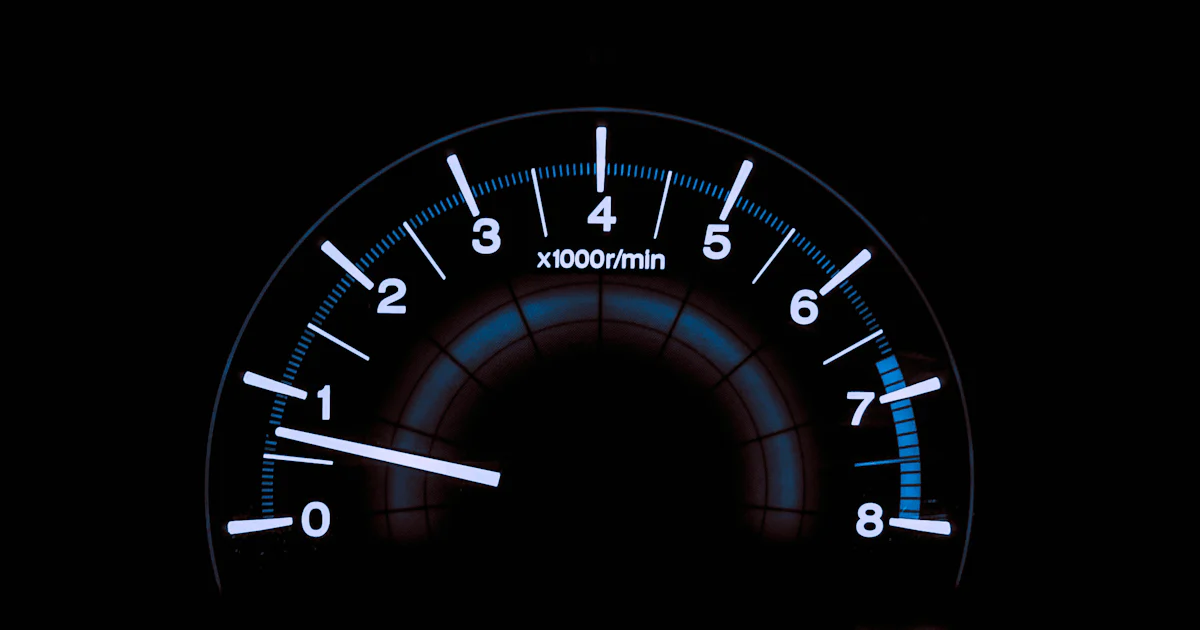
Why the speedometer depends on tire size
Your speedometer does not measure how fast you are going. It measures how fast the wheels or the gearbox output shaft are turning and converts that into km/h using a fixed circumference. That circumference is matched to the original tires. Fit a tire with a different diameter and the conversion is no longer right.
A larger tire covers more distance per revolution. At the same rotational speed you are therefore faster than the speedometer shows. A smaller tire does the opposite: the speedometer shows more than you are actually doing.
How to work out your real speed
The formula is simple:
Actual speed = speedometer reading × new diameter ÷ old diameter
An example: you switch from 205/55 R16 (631.9 mm) to 235/35 R19 (647.1 mm). The ratio is 647.1 ÷ 631.9 = 1.024. When the speedometer shows 100 km/h, you are really doing about 102.4 km/h. At an indicated 130 it is around 133 km/h. At 50 km/h in town the difference is just over 1 km/h.
| Deviation | Speedo 50 | Speedo 100 | Speedo 130 |
|---|---|---|---|
| −2% | 49.0 | 98.0 | 127.4 |
| −1% | 49.5 | 99.0 | 128.7 |
| +1% | 50.5 | 101.0 | 131.3 |
| +1.5% | 50.8 | 101.5 | 132.0 |
| +3% | 51.5 | 103.0 | 133.9 |
The tire size calculator does this calculation for any combination and plots the difference across the whole speed range.
What ECE R39 requires
Speedometer requirements are set out in UN Regulation No. 39 (ECE R39). The core rule: the speedometer must never show less than the true speed. It may read higher, by at most 10% of the true speed plus 4 km/h. At a true 100 km/h the speedometer may therefore show anything between 100 and 114 km/h.
Manufacturers use this margin. From the factory most speedometers overread by a few percent. There is a practical reason: worn tires have a smaller circumference than new ones, pressure varies, and production tolerances must be covered. The built-in margin ensures that the speedometer never reads too low, even in the worst case.
Why larger tires are the trickier case
A larger tire eats into that margin. With a big increase the speedometer can slip below the true speed, which is exactly what ECE R39 forbids. That is why the usual rule of thumb is tighter upwards than downwards: at most about +1.5%, but down to about −2%. How big the margin is on your particular car cannot be seen from the outside. No calculation replaces approval by the manufacturer or an expert.
A smaller tire is legally unproblematic, because the speedometer then tends to show more. However, the odometer and consumption display will overread, and ground clearance drops by half the diameter difference.
Speed cameras and the speedometer
If you are caught by a speed camera, what counts is the measured speed minus the measuring tolerance, not your speedometer reading. A speedometer that reads low because of the wrong tires does not protect you from a fine. What speeding costs in Germany is shown by the traffic fine calculator. To check your speedometer, compare it with a navigation app. It measures speed by satellite and is fairly accurate at a constant speed on a straight road.
Recalibrating the speedometer
On some vehicles the rolling circumference can be recoded in the control unit. This is a job for a specialist garage and must match the approved tires. Note that recoding can affect the odometer. Make sure the change is documented.
Conclusion
One percent more tire diameter means one percent more real speed. That sounds small, but at an indicated 130 km/h, +2% is already 2.6 km/h. Stick to the rule of thumb of −2% to +1.5% and settle any deviation through your papers. How to find alternative sizes is explained in the main guide Tire size explained.