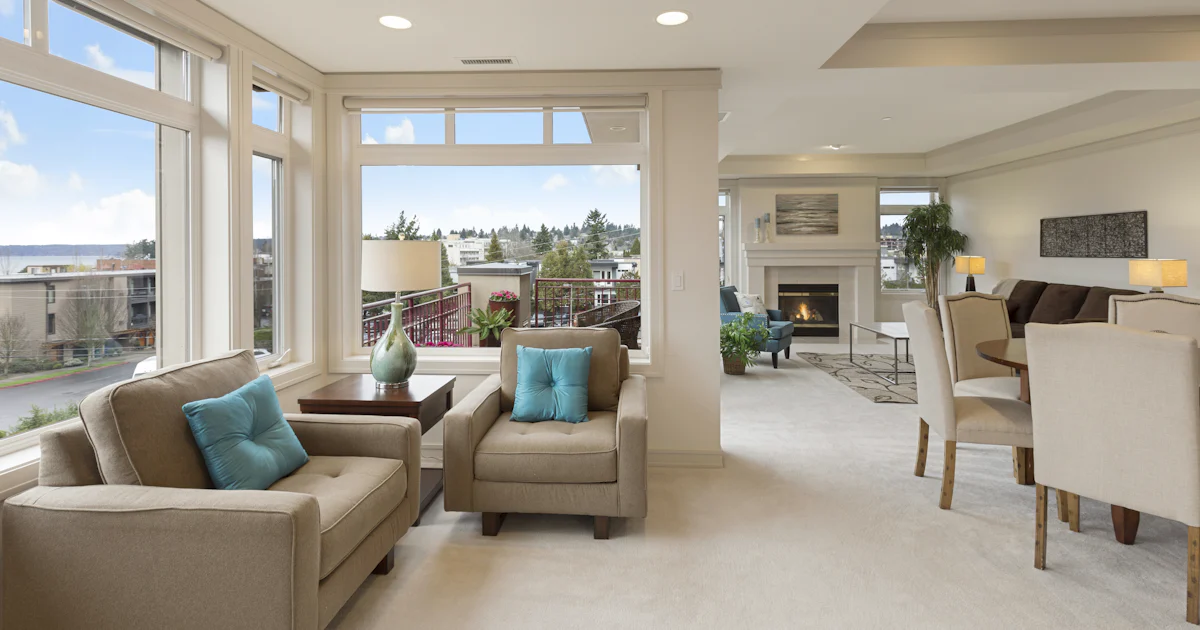
Calculating Square Meters for a Room
Calculating the square meters of a room is one of the most common everyday tasks. Whether for a rental agreement, renovation or purchasing flooring, you need to know the area.
For a simple rectangular room, measure the length and width in meters and multiply the values. A room of 4.5 m × 3.2 m has an area of 14.4 m².
L-Shaped and Irregular Rooms
For L-shaped rooms, divide the floor plan into two rectangles. Measure each rectangle individually and add the partial areas. Example: Rectangle 1 is 4 m × 3 m = 12 m², Rectangle 2 is 2 m × 2.5 m = 5 m², total area = 17 m².
For even more complex floor plans, it helps to sketch the room on graph paper and break it into as few rectangles and triangles as possible.
Sloped Ceilings and Living Space Regulations
Under the German WoFlV (Living Space Ordinance), rooms with sloped ceilings are calculated specially: areas with a clear height of at least 2 m count at 100%. Areas between 1 m and 2 m height count at only 50%. Areas below 1 m height do not count toward living space.
This means: an attic room with 20 m² floor area may only have 14 or 15 m² of living space according to WoFlV, depending on the slope.
Balconies and Terraces
Balconies and terraces are typically counted at 25% of living space (per WoFlV). An 8 m² balcony counts as 2 m² of living space. In particularly desirable locations, the factor can be up to 50%.
Tips for Accurate Measuring
Always measure at the longest points of the room, from wall to wall. Niches, window reveals and door areas belong to the room area. Non-removable built-in closets do not count. Stairs do not count toward living space, but the space under an open staircase may be partially considered.
Ideally use a laser distance measurer for precise results. These devices start at around 30 euros and measure to 1–2 mm accuracy.