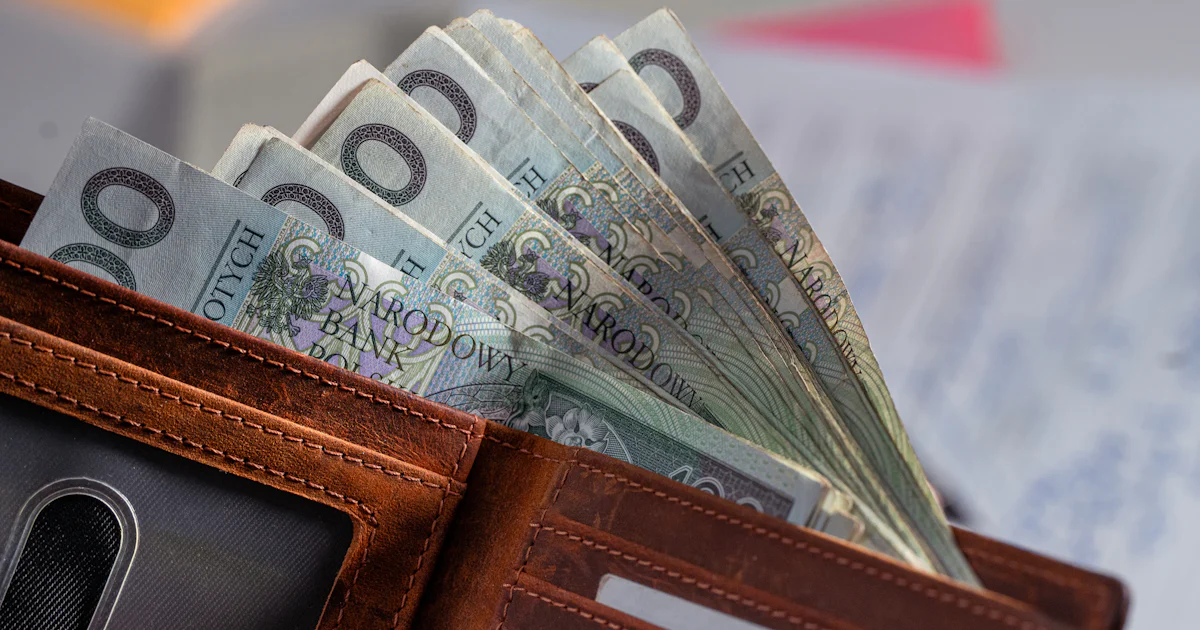
How many złoty do you get for one euro?
Poland has been a member of the European Union since 2004 but has not adopted the euro. People pay with the Polish złoty, abbreviated PLN or zł. One złoty has 100 groszy. On 24 September 2026 the ECB reference rate was 4.3823. So one euro got you about 4.38 złoty, and conversely one złoty was worth about €0.2282.
You can see the current rate at any time in the euro to złoty converter. There you will also find a quick table for €1, €10, €100 and €1,000 and the chart for the last 90 days.
A rule of thumb for on the go
In a restaurant or at the supermarket checkout you rarely have a calculator to hand. A simple rule of thumb helps: divide the złoty price by a little over four. More precisely, multiply by 0.23. A lunch for 60 zł then costs around €13.80, a bus ticket for 5 zł about €1.15.
For larger amounts the exact value is worth it. A holiday flat for 2,400 zł a week equals €547.66 at the reference rate. Even a difference of ten groszy in the rate changes the result by around €13.
How much does the złoty fluctuate?
The złoty is a freely floating currency. In the 90 days before 24 September 2026 the rate was between 4.2848 on 3 July and 4.3823 on 24 September. So the euro gained a good 2% over this period, and holidays in Poland became somewhat cheaper for travellers from the euro area. Such movements are typical. Big jumps from one day to the next, on the other hand, are rare.
Cash: exchange office or cash machine?
In Polish towns you will find many exchange offices, called kantor. In city centres their rates are often surprisingly close to the reference rate because competition is fierce. At airports, stations and tourist hotspots, however, the spread is usually much larger. Before exchanging, compare the displayed buying rate for euros with the reference rate. If it is around 4.20 instead of 4.38, you receive a good 4% less than at the reference rate.
At cash machines it depends on who runs them. Bank machines are usually fair. Machines from independent operators, often found at tourist spots, frequently charge their own fee and offer an immediate conversion into euros. Decline this conversion and choose the withdrawal in złoty without conversion.
Paying by card: in złoty, not euros
Cards are accepted almost everywhere in Poland, even for small amounts. At the terminal you are sometimes asked whether you want to pay in PLN or EUR. Choose PLN. When paying in euros, the terminal operator converts at its own, usually unfavourable rate.
Because the złoty is an EU currency, the European transparency rules apply: your card issuer must state the markup over the ECB reference rate as a percentage and inform you electronically after a card payment in another EU currency. How to put this figure into context is explained in Exchange rate markups on cards and cash.
A worked example
You spend a week in Gdańsk and spend 3,500 zł in total. At the reference rate of 4.3823 that is €798.67. If your card charges a 1.5% foreign transaction fee, about €12 is added. If instead you exchange all the money in cash at an airport exchange office with a 6% discount, you pay around €51 more. In the currency converter you can play through both variants with the “markup” field.
Is Poland cheaper than Germany?
Many everyday items, restaurant visits and services are noticeably cheaper in Poland than in Germany. In big cities such as Warsaw or Kraków, however, prices have risen considerably. The cost of living calculator shows how big the difference is for rent, groceries and leisure.
In short
1. On 24 Sep 2026, €1 was about 4.38 zł, and 1 zł about €0.23.
2. Rule of thumb on the go: złoty price × 0.23 = euros.
3. Exchange offices in the city centre are usually fair, those at airports rather expensive.
4. At terminals and cash machines, always pay in złoty, never let them convert into euros.